
 English
 Español
 Pусский
 Deutsch
 한국어
한국어 हिन्दी
 Indonesia
 Melayu
 Tiếng Việt
連続フロー光化学反応器
A Continuous Flow Photochemical Reactor is a specialized system designed to carry out light-driven chemical reactions under a continuous processing mode. Unlike traditional batch reactors, where reagents are combined and irradiated in a single vessel, a continuous flow reactor moves the reaction mixture through a controlled channel or tubing system while exposing it to a specific light source. This approach offers significant advantages in safety, efficiency, scalability, and reaction control, making it an important technology in modern chemical manufacturing and research.The basic principle of a continuous flow photochemical reactor is relatively simple. A solution containing the reactants is pumped at a carefully controlled rate through a transparent or light-permeable reactor zone. During this passage, the reaction mixture is irradiated by ultraviolet, visible, or near-infrared light, depending on the photochemical transformation being performed. Because the fluid is continuously refreshed and the path length is often short, light can penetrate more uniformly than in large batch vessels. This improves reaction consistency and often leads to higher yields and cleaner products.One of the main benefits of continuous flow photochemistry is enhanced control over reaction conditions. Parameters such as residence time, flow rate, temperature, pressure, and light intensity can be adjusted precisely. This allows chemists to optimize a reaction more easily and reproduce results with high reliability. Short residence times can reduce unwanted side reactions, while improved heat dissipation helps prevent overheating and degradation of sensitive compounds. In addition, the small internal volume of the reactor reduces the amount of hazardous material exposed to light at any given time, which improves operational safety.Continuous flow photochemical reactors are widely used in organic synthesis, pharmaceutical development, fine chemical production, and materials science. They are especially useful for reactions that require strong irradiation, rapid mixing, or highly controlled exposure to light. Common applications include photoredox catalysis, photoisomerization, halogenation, cycloaddition, and oxidation reactions. These systems are also valuable for studying reaction mechanisms, screening conditions, and scaling up laboratory processes to pilot or industrial production.The design of a continuous flow photochemical reactor may include features such as LED or laser light sources, cooling systems, reflective housings, transparent reaction channels, pumps, and inline monitoring tools. Some systems use microchannels or narrow tubing to maximize light penetration, while others employ modular configurations for flexible operation. Inline analytical tools, such as UV-Vis spectroscopy or chromatography sampling, can be integrated to monitor reaction progress in real time.Overall, a continuous flow photochemical reactor represents a powerful and modern platform for performing light-induced chemistry. By combining efficient irradiation with precise flow control, it enables safer, faster, and more scalable photochemical processes. As the demand for sustainable and high-performance chemical manufacturing continues to grow, continuous flow photochemical technology is expected to play an increasingly important role in both academic research and industrial production.
製品
カテゴリー:
-
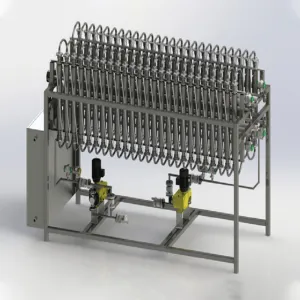
連続フロー光化学反応器
彼らの分類: 連続フロー光化学反応器ビュー: 840番号:解放時間: 2026-07-11 15:42:05連続フロー光反応器は、光化学反応を連続フロープロセスと深く統合します。従来のケトル反応器のセンチメートルレベルからミリメートルまたはマイクロメートルレベルまで光路を短縮し、光子の利用率と反応効率を大幅に向上させます。正確なマルチチャネル並列/直列構造によってサポートされ、均一な照明の下で反応物が連続的かつ安定して流れ、質量伝達と熱伝達の二重の強化を達成し、製薬、ファインケミカルおよび新素材産業に工業グレードの信頼性の高いソリューションを提供します。
ニュース
カテゴリー:
-
[Blog]光触媒リアクター光源最適化ガイド
2026-08-03 03:06:27
ケース
カテゴリー:
検索結果はありません!
ビデオ
カテゴリー:
検索結果はありません!
ダウンロード
カテゴリー:
検索結果はありません!
採用
カテゴリー:
検索結果はありません!



 ワッツアップ
 電話
電話